Couple questions game: 80 questions that get you talking, and the rules to play it
A couple questions game with real rules: 80 questions to draw at random, a one-minute timer, three passes each and a winner. From small talk to sex.
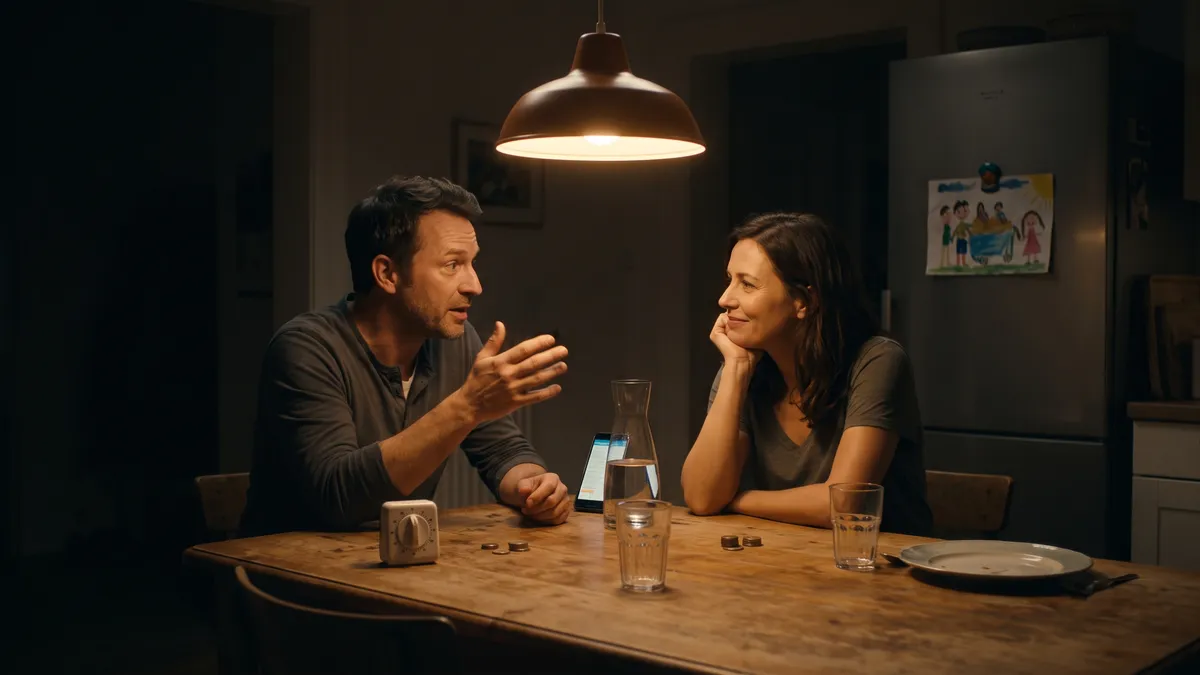
"Did you call the plumber back?" "Are you doing pickup on Thursday?" "What's for dinner?" Ten or fifteen years in, those are roughly the questions you ask each other in a day. You talk from morning to night, and you haven't actually asked each other anything.
A couple questions game exists for exactly that: asking again the questions you stopped asking, because you think you know the answer or because there's no longer time to listen to it. But it has to be a game. Most lists hand you a hundred and fifty questions and tell you the goal isn't to win anything: one of you reads, the other says "I don't know", and by question six the phone is back on the coffee table. It isn't the questions that get people talking, it's the rules you put around them.
So here are 80 questions for couples to ask each other, in five rounds that run from the week you've just had to the things you've never said, desire included. First come the six rules that make it a real game, with a timer, passes and a winner, then a random draw to deal your cards, the questions themselves, four ways to play depending on the evening, and answers to what people ask before their first game.
How to play: six rules that turn a list of questions into a game
A list read out loud quickly turns into an interrogation, and an interrogation makes nobody want to elaborate. These six rules take two minutes to learn. Each one is there for a specific reason, and it's the combination that gets you telling stories instead of giving answers.
- Ten cards a game, two per round: you don't read the list, you draw. Each of you draws one question from round 1, then one from round 2, and so on up to the fifth. Ten cards take about forty minutes, which fits between the kids' bedtime and yours. Nobody suggests an eighty-question list on a Thursday night. A ten-card game is another matter.
- Whoever draws answers first: they read the question out loud, answer it, then ask it back. So nobody asks a question they wouldn't answer themselves. And whoever speaks first sets the bar: if they really tell the story, the other one will too.
- One minute to talk, uninterrupted: start a timer for every answer. The oven timer does the job nicely, since the phone is already showing the question. For that minute, the listener doesn't finish sentences, doesn't correct and doesn't defend themselves. After ten years you complete each other's sentences without noticing, and that's exactly what stops you learning anything. If the answer runs out after twenty seconds, let the timer finish: the rest often arrives in that silence.
- One follow-up only: when the timer goes off, the listener gets one question to dig deeper, and only one. "When was that?", "and now?" or "what happened next?" are plenty. By the third follow-up you're no longer playing, you're investigating, and your partner starts watching what they say.
- Three passes each: put three coins in front of each player, or three Lego bricks borrowed from the kids' room. Skipping a question costs one pass, and nobody's allowed to ask why. Whoever runs out answers everything that comes up. You'll find people think twice before spending the last one, and end up answering questions they'd have dodged.
- The winner asks their own question: after the tenth card, whoever has the most passes left wins. The prize is one question of their own invention, written nowhere on this page, which the other answers with no pass allowed. If it's a tie, you each ask one. That last question is what gives the whole game its stakes: you hold on to your passes to earn the right to ask it, and catch yourself answering everything to get there.
To draw your cards without scrolling, use the draw below. It deals at random from a single round or from all eighty questions, and its "keep" button lets you set aside the ones you definitely want to ask another night.
All 80 cards from the article, drawn at random. Pick a family, and keep the ones you like along the way to build your own deck. Nothing is saved or sent anywhere.
Press the button to draw a card.
80 cards left.
Round 1: easy questions to get you talking again
None of these questions is about the two of you, and that's deliberate. They're about the person living next to you and what went through their head this week, in other words everything that stops getting told once conversations are for organizing tomorrow. They also let you get used to the one-minute rule while nothing is at stake.
- The laugh of the week. What made you laugh this week that you didn't think to tell me about?
- The song. Which song takes you straight back to being seventeen, and what were you doing while it played?
- The compliment. What compliment have you had lately, at work or anywhere else, that pleased you more than you let on?
- The smell. Which smell sends you straight back to childhood, and which house are you standing in?
- The worst hour. Tell me about the worst hour of your week. What would have helped right then?
- The quiet talent. What do you do better than most people and never brag about?
- A year from now. What would you like to be able to do a year from now that you can't do today, and what's stopping you from starting on Monday?
- The hideout. Where, less than an hour from here, do you feel best, and how long has it been since you went?
- The childhood dish. Which dish from your childhood would you like someone to make you one more time, and who used to cook it?
- The lost friend. Which friend you've lost touch with would you like to call, and why haven't you yet?
- The tears. Which movie or book last made you cry, and at exactly which scene?
- The white lie. What's the last white lie you told to keep the peace, and who did you tell it to?
- The unsung win. What are you proud of this year that nobody congratulated you for?
- The U-turn. What have you completely changed your mind about since we met?
- The hour to yourself. At what point in the day are you truly alone, and what do you do with it?
- The childhood dream. What did you want to be at ten, and how much of it is left in your life today?
Round 2: your story, as the other one tells it
You lived through the same years and didn't keep the same pictures. This round doesn't check who remembers best: it lets you hear your partner's version, the one you don't know even though you were there. Let the minute run to the end, because the details always come after the first sentence.
- The click. At what exact moment did you think that the two of us were going to last?
- The first telling. Who was the first person you told about me, and what did you say?
- The ordinary day. Which perfectly ordinary day with me keeps coming back to you for no reason?
- Proudest moment. When were you proudest of me?
- The address. Which of the places we've lived were you happiest in, and what was going on there?
- The decision. Which decision we made together would you make again without hesitating, and which would you make differently today?
- The gesture. What's the thing I've done that touched you most since we got together, and do I know about it?
- The hard year. Which was our hardest year, and what got us through it?
- The photo. If we could keep only one photo of us, which would you pick, and what was happening just before it was taken?
- The disguise. What did you pretend to like in the first few months, purely to impress me?
- The wish list. What did you think you were looking for in someone before you met me, and what were you wrong about?
- Our real song. Which song makes you think of us, even if it isn't the one we call "ours"?
- The brave thing. What's the bravest thing you've seen me do?
- The ritual. Which habit of ours, however tiny, would you never want to lose?
- The official version. When we tell friends how we met, which detail do we always tidy up a little, and what's the real version?
- The last twelve months. What's your best memory of the two of us from the last twelve months?
Round 3: the two of you today, the questions you stopped asking
This is the round the game exists for. You stop asking these questions the day you decide you know the answer. But the answer has changed since, several times, and nobody told anybody. This is where the passes start getting used, which is a good sign.
- Without being asked. What do I do for you without being asked that you'd never want me to stop?
- The need. What do you need right now that you don't dare ask me for?
- Closest. When in the week do you feel closest to me?
- Farthest. When do you feel farthest from me, even when we're in the same room?
- The overdue conversation. Which conversation have we been putting off for too long?
- The drain. What's wearing you out most right now that I probably don't see?
- The invisible job. What do you do for the house or the family that you'd like me to finally notice?
- Being heard. When did you last feel really listened to by me, and what were we talking about?
- A Tuesday in ten years. Ten years from now, what does an ordinary Tuesday evening at our place look like, the way you picture it?
- The envy. What do you envy about another couple we know?
- The thank-you. What would you like me to thank you for, once and for all?
- The hug that didn't happen. When did you last want to put your arms around me and didn't? What stopped you?
- The blank spot. Which part of your days do I know least about?
- The argument that went quiet. What have we stopped arguing about only because we stopped talking about it?
- Angry at bedtime. When we go to bed angry, what would you like me to do?
- The upgrade. What has changed for the better in me since we met?
Round 4: desire, what starts it and what kills it
This round doesn't ask what you'd like to try. It asks how your desire works today: what sets it off, what stops it dead, what it needs before and after. It's information you think you've had for years, and which actually dates from your first years together. Every answer can be used the very next time you have sex.
- The tells. How can you tell I want you, before I've said a word?
- The approach. Which way of suggesting sex nearly always works on you, and which never does?
- The mood killer. What kills the mood for you every time, even on a night when everything was going well?
- The hour before. What do you need, in the hour beforehand, to be in the mood?
- Twenty-five. What turned you on at twenty-five and doesn't do much for you now? And the other way around?
- The compliment you don't believe. Which compliment about your body would you like to hear more often, and which one do you never believe when I say it?
- The body. When do you feel good in your body, and when not at all?
- After a fight. After a fight, how long before you want me to touch you again, and what shortens that?
- The fifteen minutes after. Right after sex, what do you want in the fifteen minutes that follow?
- The kiss. Of all our kisses, which one do you remember best, and where were we?
- Nowhere near the bed. What makes you feel wanted by me on an ordinary day, nowhere near the bedroom?
- The guess. What do you do in bed because you think I like it, without being completely sure?
- The nudge. What helps you come that I might not know about?
- The day after. What makes you still think about it the next day, after a time we've had sex?
- The shyness. What still embarrasses you in front of me, after all these years?
- The habit to keep. In the way we have sex, which habit would you never want us to change?
Round 5: the questions you save for last
Here every card can cost you, and this is when you're glad you kept a pass. This round goes where things don't get said: other people, doubt, being turned down, what you blame yourself for. You don't have to go there in your first game. Played in four rounds and eight cards, it ends the same way, with the winner's question.
- The unsaid. What have you never told me for fear I'd take it badly?
- Jealousy. Who have you been jealous of, even for one evening, since we got together?
- Being hit on. Tell me about the last time someone hit on you since we've been together, and what you said back.
- The one before. What have you kept from a relationship before me: a habit, a taste, a lesson?
- Without me. If we'd never met, where do you think you'd be today?
- The blame you take. What do you blame yourself for, in our relationship?
- The doubt. Tell me about a moment when you doubted us. What made you stay?
- The confidant. Who do you talk to when things aren't good between us, and what do they tell you?
- The phone. Have you ever looked through my phone, or badly wanted to? What were you looking for?
- The no. When I say no one night, what do you hear? And when you're the one saying no, what would you like me to understand?
- Mismatched nights. On the nights when one of us wants sex and the other doesn't, what would you like us to do instead of turning our backs?
- The inheritance. What were you taught about sex, at home or anywhere else, that took you years to shake off?
- Forgiveness. What would you like me to forgive you for?
- The drawer. Which dream did you put away in a drawer marked "later", and is it still in there?
- The lie. What's the biggest lie you've ever told me, and what was it for?
- The overdue compliment. Which compliment do you never pay me because you assume I already know?
Four ways to play, depending on the evening
The ten-card game is the full version, and it isn't the only one. The same questions can be played in ten minutes or over three hundred miles of highway, as long as you adapt the rules instead of dropping them.
- The full game, forty minutes on the couch: ten cards, the timer, the coins on the coffee table and the winner's question to finish. Play this one the first time, because it's what builds the habit of answering for a whole minute.
- Three cards in bed, lights off: on a night when you've only got ten minutes, draw three questions from a single round, turn the screen brightness down, and forget the timer and the passes. In the dark you can't see the face your partner makes while listening, and a lot of answers come out more easily. Round 2 suits this especially well, and if the conversation slides toward something other than words, the whispered memory from our sensual games for couples picks up exactly there.
- The car version, on a long drive: whoever isn't driving reads the questions, and you stick to rounds 1 to 3 until the kids are asleep in the back. The driver is looking at the road, not at the passenger, and that's an advantage: some things are easier to say to a windshield. The timer becomes pointless, since nobody's in a hurry on the highway.
- The version with dares, once the passes run out: whoever has no coins left and still refuses a question owes a dare, chosen by the other and done on the spot: one item of clothing off, a one-minute kiss, a shoulder massage. From that point you're not quite playing a question game anymore. If that's the slope you like, truth or dare for couples follows it all the way down on your phone: each turn you choose a truth or a dare, a truth scores one point, a dare two, a refusal none, and the game keeps score.
If you're after other games for a weeknight, the kind you start at the table or during an episode, our at-home date night games for a weeknight pick up from there, with nothing but a phone.
Question game, quiz, yes or no, or would you rather: which one tonight?
These four games look alike from a distance, and they aren't for the same thing at all. In English, "couple questions game" is used both for the talking game on this page and for the newlywed-style quiz where you guess each other's answers, so it's worth knowing which one you came for.
| The game | What you do | What you get out of it | For which night |
|---|---|---|---|
| The question game on this page | You tell the story, one minute each | What's behind an answer | The one when you want to talk |
| The funny couples quiz | You guess your partner's answer and keep score | What you thought you knew, and is no longer true | The one when you want to laugh |
| Yes or no questions for couples | You answer in one word, no explaining | The list of what tempts you both | The one when talking about sex still feels daunting |
| Dirty would you rather questions | You pick between two options in five seconds | What comes first, between two things you want | The one when you've already tried a lot |
Nothing stops you running them one week after the other: the quiz to laugh at what you've forgotten, the question game to hear what has changed, then yes or no and would you rather to decide what to do about it. And on the night you mostly want to find out what your partner has already done, bring out the never have I ever questions for couples.
Your questions about the couple questions game
What are good questions for couples to ask each other?
The ones you think you already know the answer to. "When in the week do you feel closest to me?" or "what do you need right now that you don't dare ask me for?" sound simple, and you'll find you'd have bet on a different answer. Questions about tastes, a favorite color or a favorite movie, teach you nothing after ten years: go for the ones that ask for a moment, a place or a reason. Round 3 is made of those.
What if my partner just says "I don't know"?
Nothing, and that's the whole point of the minute: they have fifty seconds left, and the silence is working for you. "I don't know" is nearly always a first answer, the one people give while they check that the real one will land well. Since whoever drew the card has already answered before them, they've also just heard an example of what's expected. And if they truly don't know, they still have a pass.
How do I suggest a question game without it sounding like "we need to talk"?
By never saying that sentence. Ask question 9 while you're making dinner, as if it had just crossed your mind, and answer it yourself first. If the conversation takes off, announce the rest for a specific evening: "Thursday, ten cards, forty minutes, and the winner asks whatever they want". A game with a date and a limit is much harder to turn down than a talk with no end in sight. If round 4 is the part you're nervous about announcing, our piece on how to suggest a naughty game to your partner covers the words and the timing.
Does a question game really need a winner?
Yes, because the stakes are what give the passes a price. If skipping costs nothing, you skip as soon as a question gets uncomfortable, which is precisely when it gets interesting. With three coins to hold on to and a free question to win, people think twice, and answer things they'd have let slide. Nobody loses much either: the loser owes one answer, nothing more.
What if an answer hurts?
You get one follow-up, not a right of reply, and that's what protects the game. Use it to understand ("since when?"), draw the next card, and only come back to the subject the next day, if it's still on your mind. Something said in a game because a card asked for it isn't an accusation. It's information you didn't have, which your partner chose to give you rather than spend a pass.
Can we play again with the same questions?
Yes, and you should. Eighty cards make eight games without ever landing on the same one, and the answers in rounds 1, 3 and 4 change from one season to the next: the worst hour of the week, what's wearing you out, what puts you in the mood. Drawing the same card six months later and hearing a different answer is one of the best moments the game has.